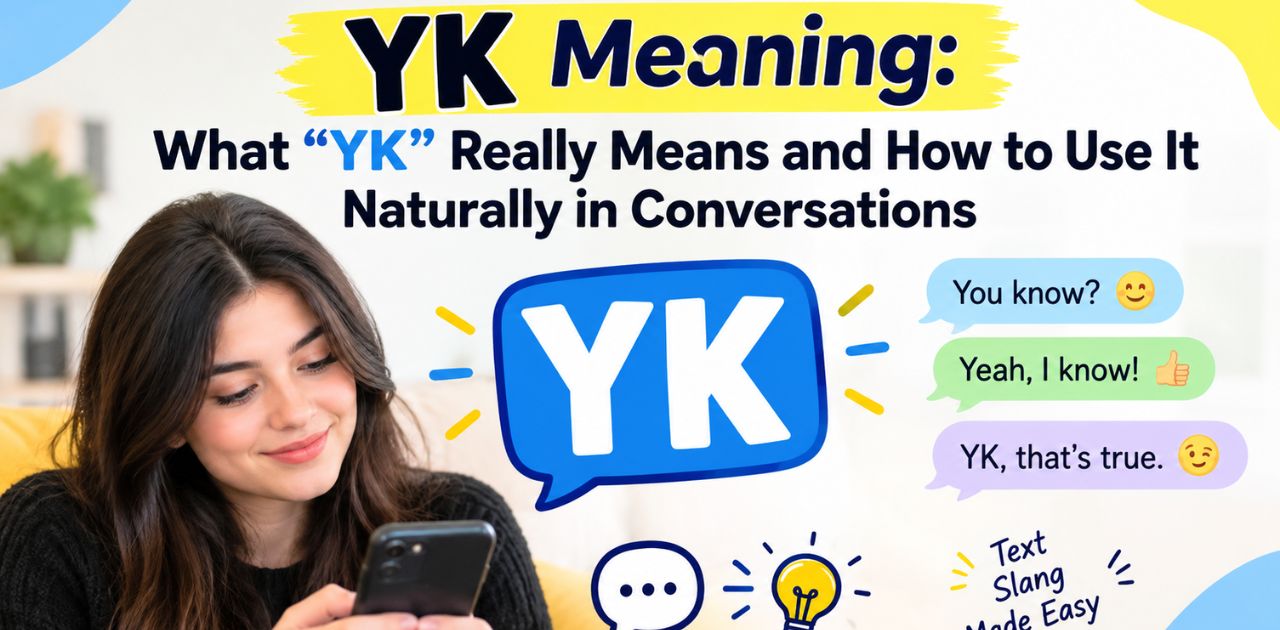

Have you ever received a text ending with “yk” and wondered what the sender meant? In most casual conversations, YK Meaning is “you know.” People use this short abbreviation in text messages, social media comments, and online chats to make conversations quicker and more natural.
However, the meaning can change depending on the sentence, relationship, and tone. Sometimes, “yk” helps someone explain a feeling, share something familiar, or check whether the other person understands. In other situations, it may sound playful, flirty, or slightly sarcastic.
This guide explains what YK means, how people use it in everyday digital communication, and how to respond naturally without misunderstanding the message.
What Does YK Mean?
The most common meaning of “yk” is “you know.” It is an informal abbreviation used in texting and online communication. People often type it when they want to express a thought, refer to something familiar, or make a conversation sound relaxed.
For example, someone might write, “I was tired yesterday, yk.” Here, the abbreviation adds a casual conversational tone rather than introducing a completely new idea.
The exact YK Meaning depends on the sentence. In some conversations, it can suggest “you know what I mean” or “you already know.” The surrounding words and the relationship between the people usually make the intended meaning clearer.
Example:
- “I thought the movie might be boring, but I ended up enjoying it.” — The speaker shares an unexpected positive reaction to the film.
- “I just wanted to spend some time by myself, you know.” — The person is explaining that they needed a little personal space.
- “YK, we talked about this before.” — The sender is referring to something familiar.
Because “yk” is informal slang, it works best in friendly conversations rather than formal writing.
Common Ways “YK” Is Used in Text Messages

Although “you know” is the most common interpretation, people use “yk” in slightly different ways. Understanding the sentence helps you identify what the sender is trying to communicate.
1. “You Know”
This is the standard interpretation of “yk” in texting. It can fill a small pause, connect ideas, or make a statement feel more conversational.
Example: “I love quiet places, yk.”
The sender is expressing a preference in a relaxed way. The abbreviation does not necessarily ask a question or require a response.
2. “You Know What I Mean”
Sometimes, “yk” suggests that the sender expects the other person to understand the feeling or situation without a long explanation.
For example: “You know, it was just one of those days, yk.”
Here, the sender may be communicating frustration or tiredness while assuming the reader can relate.
Although people sometimes interpret “yk” as “you know what I mean,” the full phrase is not always its literal meaning. Context matters.
3. “You Already Know”
In conversations between friends, “yk” can refer to something both people already understand.
Example: “You know I’m always there for you, yk.”
Depending on the conversation, the sender might be emphasizing a familiar fact or reminding someone of an established connection.
4. Softening a Statement
People also use “yk” to make a statement sound less direct. It helps the message sound more casual and natural when sharing an opinion or explaining a feeling.
Example: “I decided to have a quiet night at home rather than make plans, yk.” — The speaker explains their choice to spend the evening relaxing indoors.
The sender may be explaining their decision without making it sound overly serious. Still, the abbreviation does not automatically make every message polite; the rest of the wording matters.
Origin and Evolution of YK
“YK” developed as part of the broader habit of shortening words and phrases in digital communication. Early SMS texting encouraged people to use fewer characters, while instant messaging and online communities helped informal abbreviations spread. As social media platforms, group chats, and mobile messaging became everyday communication tools, expressions such as “LOL,” “IDK,” and “IK” became widely recognizable. “YK” fits the same pattern: it is quick to type and easy to use in casual conversation.
Today, people may use it in text messages, Instagram DMs, Snapchat chats, TikTok comments, and gaming conversations. Its popularity and interpretation can vary by age group, online community, and personal texting habits. The abbreviation is not limited to one generation, although informal online slang is often associated with younger users. Ultimately, the meaning comes from how people use it, not simply from who types it.
What Does “YK” Mean When Used at the End of a Sentence?

When someone adds “yk” at the end of a sentence, it usually makes the message sound more casual, friendly, and conversational. The sender may be emphasizing a feeling, making a statement sound less formal, or suggesting that the reader understands the situation.
Consider these examples:
- – “This week has been pretty exhausting, yk.” — A casual way to explain that someone has had a lot going on.
- “Being there always brings back memories of home, yk.” — A way to share a personal feeling.
- “I was only trying to do something nice, yk.” — A way to clarify intentions and sound reassuring.
At the end of a sentence, “yk” usually stands for “you know.” Its exact tone depends on the context and can express familiarity, emotion, or a desire to make a point feel more relatable. A friendly message may sound warm, while a message during an argument may feel impatient or defensive. Consider the entire conversation before deciding what “yk” means, rather than interpreting the abbreviation on its own. Punctuation, previous messages, and your relationship with the sender can all help you interpret the tone.
How “YK” Is Used in Different Contexts
The abbreviation appears across different digital spaces, but its tone can change depending on the platform and situation.
1. In Text Messages
In SMS texting and private chats, “yk” is commonly used between friends, family members, and people who already know each other.
Examples include:
- “I’ll call you later, yk.”
- “It’s been a long day, yk.”
- “You get what I’m saying, yk?”
People often use it naturally in casual chats to make their messages sound more relaxed. Since texting does not include facial expressions or vocal tone, readers sometimes need the surrounding context to understand the sender’s intention.
2. On Social Media
On platforms such as TikTok, Instagram, and Snapchat, “yk” may appear in captions, comments, stories, and direct messages.
For example, someone might write, “Summer nights hit differently, yk.” The abbreviation makes the caption sound conversational and suggests a feeling that others might recognize.
The YK Meaning on social media generally follows its usual texting meaning, but individual communities can develop their own habits.Keep in mind that its meaning and tone can vary depending on the context in which it appears.
3. In Music and Pop Culture
Informal abbreviations often appear in online discussions about music, celebrities, entertainment, and popular trends. People may use “yk” while commenting on lyrics, sharing opinions, or talking about a relatable moment.
For example, a fan might comment, “This song takes me back, yk.”
The abbreviation itself does not have a special music-related definition in this example.It mainly makes the person’s response sound more relaxed and conversational. If a particular song or creator uses “YK” differently, the surrounding lyrics or context would be needed to establish that meaning.
Is “YK” Rude, Flirty, or Offensive in Text Messages?
Usually, “yk” is not inherently rude, flirty, or offensive. “YK” is generally an informal abbreviation, not a rude or offensive expression. Its tone depends on the surrounding message and the relationship between the people chatting.
When It Feels Friendly
When used between friends, it often makes a message feel more natural, friendly, and familiar.
Example: “We always end up laughing at the same things, yk.”
The sender is highlighting a shared experience. In this situation, “yk” can make the message sound more natural and personal.
When It Feels Flirty
In a conversation with a romantic interest, “yk” may appear in a playful or emotionally suggestive message.
Example: “You have a real talent for lifting people’s spirits, yk.” — A warm, informal way to appreciate someone who brings positivity to others.
The sentence may sound flirty because of the compliment, not because “yk” automatically signals romantic interest. One abbreviation is not enough to determine someone’s feelings.
When It Feels Annoying
Repeated use of “yk” can sometimes feel unnecessary, especially if the sender uses it after almost every sentence. During a disagreement, it may also sound impatient if paired with dismissive wording.
Example: “I already explained it, yk.”
Depending on the situation, this might sound frustrating. The same abbreviation could feel completely different in a relaxed conversation.
Tone Depends on the Message
To interpret the tone, consider:
- Pay attention to the wording: Does the message express kindness, playful teasing, or frustration? The surrounding words can help you understand the sender’s intended tone.
- Your relationship: Are you close friends, new acquaintances, or coworkers?
- The conversation: Is it a joke, a serious discussion, or a disagreement?
- The pattern: Does the person regularly use texting abbreviations?
The abbreviation alone does not prove that someone is flirting, being disrespectful, or trying to offend you.
Common Misunderstandings About YK

A common mistake is assuming that “yk” always communicates the same emotion. Although “you know” is the usual meaning, the phrase can serve different purposes depending on the sentence. Another misunderstanding is treating it as a guaranteed sign of romantic interest. Someone may use “yk” simply because it is part of their normal texting style.
People may also confuse “YK” with “IK.” These abbreviations are different: “YK” usually means “you know,” while “IK” commonly means “I know.” Finally, capitalization does not always signal a different definition. Some people type “yk,” while others write “YK.” In ordinary texting, both forms can represent the same abbreviation.
Quick Tip:
If you are unsure what the sender means, read the complete message and consider the context. When the meaning still is not clear, ask a simple question such as, “What do you mean by that?” rather than guessing.
Similar Slang and Alternatives
There are several other abbreviations and expressions you may see in digital conversations.
- IK: Usually means “I know.”
- IDK: Means “I don’t know.”
- IMO: Means “in my opinion.”
- TBH: Means “to be honest.”
- BTW: Means “by the way.”
- “You get what I’m trying to say” — A natural way to check whether someone understands your point.
- “You’re already familiar with that” — A clearer expression used when both people have prior knowledge of something.
Although these phrases can sometimes replace “yk,” they don’t always convey the same meaning. Choose the wording that best fits your message and the level of formality you want.
When to Use YK vs. IK
The difference is straightforward:
| Abbreviation | Common meaning | Example |
| YK | You know | “It was a great day, yk.” |
| IK | I know | “IK, that was so funny.” |
| IDK | I don’t know | “IDK what time it starts.” |
Use “yk” when you are expressing a thought or referring to something familiar. Use “ik” when you are saying that you already know something. Use “idk” when you are unsure.
How to Respond When Someone Uses YK
In most casual conversations, you do not need a special response to “yk.” Reply to the message’s actual meaning rather than focusing only on the abbreviation.
For example:
- Message: “That was such a good movie, yk.”
Reply: “Right? I really enjoyed it too.” - Message: “I’ve had a stressful week, yk.”
Reply: “I get that. Hope things get easier.” - Message: “You know I always support you, yk.”
Reply: “I appreciate that. It means a lot.”
If the meaning is unclear, it is perfectly fine to ask the sender what they mean. You do not have to copy their slang to sound natural, either. A clear, friendly response works just as well.
Tips for Natural Replies:
- Match the conversation’s tone without forcing slang.
- Focus on what the other person is actually saying rather than the abbreviation itself.
- If you want to continue the discussion, ask a relevant question that encourages them to share more.
- Avoid assuming romantic interest or sarcasm without other clues.
- Choose clear wording when the discussion is serious.
YK in Dating Apps and Online Communities
On dating apps, “yk” may appear in profile conversations, playful messages, or discussions about shared interests. A person might write, “I love spontaneous road trips, yk,” to express a preference casually. However, the abbreviation is not inherently romantic. The surrounding message, the person’s communication style, and the conversation as a whole offer better clues about their intentions.
In gaming groups and online chats, brief phrases are popular because they help people communicate quickly without interrupting the flow of conversation. “YK” can fit naturally into a message between teammates or friends who are discussing a familiar situation. Different communities may develop different slang habits. If an abbreviation appears in a specialized group, consider whether the discussion provides a specific meaning before interpreting it as ordinary texting slang.
Read More: What Does a Green Heart Emoji Mean, and How to Respond to It?
Cultural and Regional Variations
The use of “yk” can vary according to personal habits, age groups, language preferences, and online communities. Some people use it regularly, while others prefer complete phrases such as “you know” or “you know what I mean.”
People who speak English as an additional language may interpret informal abbreviations differently, especially when tone depends on cultural context. A message that feels friendly to one person may seem confusing or overly casual to another.
When communicating across cultures, clear language is often the safest option. If you are unsure whether the other person understands an abbreviation, writing out the complete phrase can prevent confusion.
Hidden or Controversial Meanings
In ordinary texting, “yk” most commonly stands for “you know.” However, abbreviations can have alternative meanings in specific communities, private jokes, names, or specialized contexts.
For instance, “YK” might be used as initials or as part of a name. Some people may also use it creatively in online profiles or usernames. These uses do not mean that every appearance of “YK” has a hidden definition.
There is no reliable reason to assume that “yk” is offensive or controversial by itself. If you encounter it in an unfamiliar setting, check the full sentence and the topic being discussed before deciding what it means.
Is “YK” Appropriate for Work or Academic Settings?

Although “yk” is common in informal digital communication, it is generally better to avoid it in formal emails, academic assignments, official reports, and professional documents.
In workplace messages, clarity matters more than saving a few characters. Writing “you know” or explaining the idea directly can make your message easier for colleagues, clients, and readers to understand.
In a casual team chat, the abbreviation may be acceptable if everyone uses informal language. However, when contacting someone for the first time or discussing an important matter, complete wording is usually the better choice.
Example Comparison:
Informal chat:
“It’s been a busy week, yk.”
Professional message:
“My schedule has been quite full this week. Thank you for your understanding.”
The second example communicates the thought more clearly and is suitable for a wider range of professional situations.
When You Should Avoid Using “yk meaning in text”
Although “yk” is useful in casual conversations, there are situations where a clearer expression is more appropriate.
Professional Settings
Avoid relying on informal abbreviations in job applications, client emails, formal presentations, and academic writing. Spell out your meaning so that readers can understand your message without interpreting slang.
Cross-Cultural Chats
If you are communicating with someone who may not recognize English texting abbreviations, use complete phrases. This helps prevent confusion and makes your message more inclusive.
Sensitive Situations
When discussing personal problems, misunderstandings, serious decisions, or emotional concerns, choose words that communicate your meaning directly. A short abbreviation may sound dismissive even when that is not what you intended.
In these situations, clarity and empathy are more important than typing quickly.
Quick Reference Summary Table
| Term or context | Meaning or use |
| YK | Usually “you know” |
| YK in a text | An informal conversational expression |
| YK at the end of a sentence | Often adds emphasis or a familiar tone |
| YK on social media | It frequently appears in casual online conversations, including social media updates, replies, and one-on-one chats. |
| YK in dating conversations | May appear in friendly or flirty messages, but is not automatically romantic |
| YK vs. IK | “You know” versus “I know” |
| YK in professional writing | Usually best replaced with clearer, complete wording |
| YK tone | Depends on the sentence and conversation |
FAQs
What does YK mean in texting?
YK usually means “you know.” People use it in casual messages to express a thought, refer to shared knowledge, or make a sentence sound conversational. The exact YK Meaning depends on the context.
What Does YK Mean When Someone Adds It to the End of a Text Message?
At the end of a text, “yk” often adds emphasis or suggests that the reader understands the sender’s point. The sentence and the relationship between the people help clarify the tone.
Does YK mean “you already know”?
Sometimes, it can suggest “you already know,” particularly when the people involved share background knowledge. However, “you know” remains the most common interpretation.
Is YK rude or disrespectful?
No, not by itself. It is generally an informal abbreviation. The wording and situation determine whether the complete message sounds friendly, impatient, or disrespectful.
Does YK mean someone is flirting?
Not necessarily. It may appear in a flirty conversation, but the abbreviation alone does not indicate romantic interest. Look at the full message and the person’s behavior.
What is the difference between YK and IK?
YK usually means “you know,” while IK means “I know.” They communicate different ideas, so they should not be treated as interchangeable.
What Does YK Stand for on TikTok and Instagram?
On these platforms, “yk” usually has the same meaning as in ordinary texting. People often use “yk” in social media captions, comment threads, and private chats to keep their messages short and informal.
Is “YK” Suitable for Workplace Messages?
It’s best to spell out your meaning in professional conversations rather than use casual abbreviations like “yk” Writing “you know” or expressing your point directly is clearer and more appropriate for professional or academic situations.
Conclusion
Understanding YK Meaning makes everyday texting and online communication easier to follow. In most situations, “yk” stands for “you know” and helps people express thoughts in a casual, familiar way. Its tone can vary depending on the sentence, relationship, and context. It may sound friendly, playful, or occasionally impatient, but the abbreviation itself is not automatically rude or flirty.
Use “yk” when it fits a relaxed conversation, and choose complete wording when clarity matters. Most importantly, read the whole message before assuming what the sender intends. That simple habit can help you understand texting slang more naturally and avoid unnecessary misunderstandings.

salheen is the founder of WishForLoves.com, a global platform dedicated to sharing heartfelt wishes, love messages, and inspiring quotes for every occasion. With a passion for positive communication and meaningful words, Asim helps people express emotions beautifully and connect with their loved ones worldwide.
He specializes in SEO-friendly content, guest posting, and digital storytelling that touches hearts. When he’s not writing, Asim loves exploring new ideas about motivation, relationships, and self-growth — all through the power of words.
